Greek last names and meanings carry stories about family history, culture, and ancient traditions. Many come from Greek words, personal names, places, or occupations. Some describe a person’s appearance or character. Others show a connection to a parent or a particular region.
These surnames can also offer clues about Greece’s rich past. For example, names ending in opoulos are often linked to family descent. Names ending in akis are commonly found in Crete. Meanwhile, surnames ending in idis or ides often have historical roots in Asia Minor and Pontus.
If you are researching Greek heritage or looking for a meaningful surname, this collection offers plenty of ideas. Each name includes a meaning or a brief explanation where its origin is known.
Popular Greek Last Names and Their Meanings
Many Greek surnames are widely recognized because of their long history and family traditions. Some come from personal names, while others describe family connections or occupations.
- Papadopoulos: Son or descendant of a priest.
- Papadakis: A surname connected to a priest, often associated with Crete.
- Pappas: Priest or a person connected with the church.
- Georgiou: Of George or belonging to George.
- Dimitriou: Of Dimitris or belonging to Dimitris.
- Ioannou: Of Ioannis, the Greek form of John.
- Nikolaou: Of Nikolaos, meaning victory of the people.
- Christodoulou: Servant of Christ.
- Vasileiou: Of Vasileios, meaning kingly or royal.
- Konstantinou: Of Konstantinos, meaning constant or steadfast.
- Anagnostopoulos: Descendant of Anagnostis, a name linked to a reader.
- Theodorou: Of Theodoros, meaning gift of God.
- Alexandropoulos: Descendant of Alexandros, meaning defender of people.
- Michailidis: Descendant of Michail, the Greek form of Michael.
- Angelopoulos: Descendant of Angelos, meaning messenger or angel.
- Karagiannis: A compound surname formed from Kara and Giannis.
- Panagiotopoulos: Descendant of Panagiotis, a name linked to the Virgin Mary.
- Athanasopoulos: Descendant of Athanasios, meaning immortal.
- Stavropoulos: Descendant of Stavros, meaning cross.
- Galanis: A surname traditionally associated with blue or blue eyed features.
These names reflect common Greek naming patterns. However, a surname’s exact family history may differ from its general meaning.
Greek Last Names With Ancient Greek Origins
Ancient Greek language and culture have shaped many modern surnames. Some names come from ancient personal names, while others are linked to old Greek words and historical traditions.
- Aristidis: From Aristides, an ancient Greek personal name associated with excellence.
- Aristotelis: From Aristotle, a famous ancient Greek philosopher’s name.
- Periklis: From Pericles, an important Athenian statesman.
- Sokratis: From Socrates, a well known ancient Greek philosopher.
- Platon: From Plato, the name of the ancient Greek philosopher.
- Leonidas: From an ancient Greek name meaning lion like.
- Heraklis: From Heracles, the legendary Greek hero.
- Achilleas: From Achilles, the hero of the Trojan War.
- Odysseas: From Odysseus, the hero of the Odyssey.
- Demosthenes: An ancient Greek personal name associated with strength of the people.
- Euripidis: From Euripides, the ancient Greek tragedian.
- Sophoclis: From Sophocles, the ancient Greek playwright.
- Pythagoras: From the name of the ancient Greek mathematician and philosopher.
- Aeschylou: A surname connected with the ancient name Aeschylus.
- Homerou: A surname associated with Homer, the ancient Greek poet.
- Pindarou: Connected with Pindar, an ancient Greek lyric poet.
- Thoukydidis: From Thucydides, the ancient Greek historian.
- Aristarchou: Connected with the Greek personal name Aristarchos.
- Xenophontos: From Xenophon, an ancient Greek historian and philosopher.
- Isokratis: From Isocrates, an ancient Greek teacher and speaker.
Some surnames preserve the names of famous people from Greek history. Others simply share a linguistic connection with ancient Greek personal names.
Greek Last Names Ending in opoulos
The ending opoulos is one of the best known features of Greek surnames. It is commonly understood as “son of” or “descendant of.” It is especially common in the Peloponnese.
Here are examples of surnames with this ending:
- Papadopoulos: Descendant of a priest.
- Georgopoulos: Descendant of Georgios.
- Dimitropoulos: Descendant of Dimitris.
- Nikolaopoulos: Descendant of Nikolaos.
- Christopoulos: Descendant of Christos.
- Theodoropoulos: Descendant of Theodoros.
- Alexopoulos: Descendant of Alexios or Alexandros.
- Konstantopoulos: Descendant of Konstantinos.
- Vasiliopoulos: Descendant of Vasilios.
- Panagopoulos: Descendant of Panagiotis.
- Stavropoulos: Descendant of Stavros.
- Michalopoulos: Descendant of Michalis.
- Angelopoulos: Descendant of Angelos.
- Athanasopoulos: Descendant of Athanasios.
- Ioannopoulos: Descendant of Ioannis.
- Markopoulos: Descendant of Markos.
- Petropoulos: Descendant of Petros.
- Stefanopoulos: Descendant of Stefanos.
- Charalampopoulos: Descendant of Charalambos.
- Sarantopoulos: Descendant of Sarantos.
The name before opoulos usually identifies the older personal name in the family line. The ending itself does not provide the full family story.
Greek Last Names Ending in idis and ides
The endings idis and ides are strongly associated with Greek surnames. They are especially connected with families from Pontus and other parts of Asia Minor. These endings often express descent or family connection.
- Georgiadis: Descendant of Georgios.
- Dimitriadis: Descendant of Dimitrios.
- Nikolaidis: Descendant of Nikolaos.
- Christidis: Descendant of Christos.
- Theodoridis: Descendant of Theodoros.
- Ioannidis: Descendant of Ioannis.
- Alexandridis: Descendant of Alexandros.
- Konstantinidis: Descendant of Konstantinos.
- Vasileiadis: Descendant of Vasileios.
- Papadopoulos: A priest related family name, although it does not use this ending.
- Michailidis: Descendant of Michail.
- Stavridis: Connected with the personal name Stavros.
- Panagiotidis: Descendant of Panagiotis.
- Athanasidis: Descendant of Athanasios.
- Markidis: Connected with the personal name Markos.
- Petroudis: A surname formed from the name Petros.
- Charalampidis: Descendant of Charalambos.
- Sarantidis: Connected with the name Sarantos.
- Kostidis: A surname linked to Kostas.
- Antonidis: Descendant of Antonios.
These endings can help identify regional naming traditions. Still, not every family with the same surname has the same ancestry.
Greek Last Names Ending in akis
The ending akis is strongly associated with Crete. It is often a diminutive or affectionate form of a personal name. Over time, these forms became permanent family surnames.
- Georgakis: A form connected with Georgios.
- Dimitrakis: A diminutive form of Dimitris.
- Nikolakis: A form of Nikolaos.
- Manolakis: A form of Manolis.
- Kostakis: A form of Kostas.
- Michalakis: A form of Michalis.
- Giannakis: A form of Giannis.
- Stavrakis: A form connected with Stavros.
- Petrakis: A form of Petros.
- Theodorakis: A form of Theodoros.
- Antonakis: A form of Antonios.
- Vasilakis: A form of Vasilis.
- Christakis: A form of Christos.
- Markakis: A form of Markos.
- Sifakis: A traditional Cretan surname.
- Lyrakis: A surname found in Crete.
- Kourakis: A surname associated with Cretan naming traditions.
- Papadakis: A priest related surname with a common Cretan form.
- Mavrakis: A surname connected with the Greek word for black or dark.
- Daskalakis: A form related to daskalos, meaning teacher.
The ending akis is a useful clue to Cretan heritage, but it does not prove that every family with the ending comes from Crete.
Greek Last Names and Meanings Based on Occupations
Many Greek surnames developed from the work people did. These names helped identify families in towns and villages. Some still preserve the memory of traditional trades.
- Papadopoulos: Connected with a priest or priest’s family.
- Pappas: Priest.
- Daskalakis: Related to daskalos, meaning teacher.
- Raptis: Tailor.
- Tsagkaris: Shoemaker.
- Psaras: Fisherman.
- Mylonas: Miller.
- Katsaros: A surname with several possible origins, including a nickname.
- Koutouzis: A surname with regional and historical variations.
- Kalogeros: Monk or a religious man.
- Kafetzis: Connected with a coffee seller or coffeehouse worker.
- Sideris: Related to sidero, meaning iron.
- Mastoras: Craftsman or skilled worker.
- Bakalis: A traditional term for a small shopkeeper or grocer.
- Kamaras: A surname with a possible connection to an arch or vaulted structure.
Occupational meanings can change over time. Some surnames also developed from nicknames or local words, so their original use is not always certain.
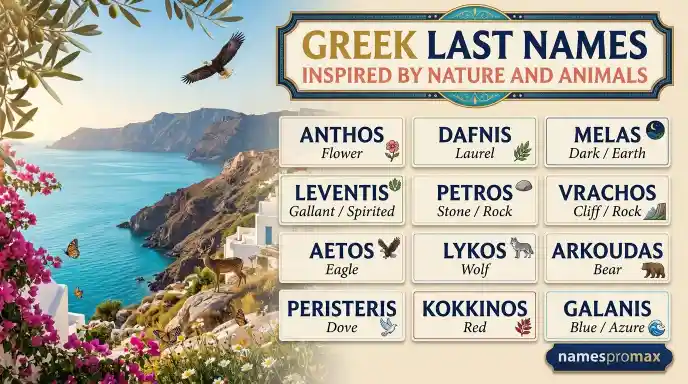
Greek Last Names Inspired by Nature and Animals
Nature has influenced Greek names for generations. Some surnames come from animals, plants, colors, and natural features. Others began as nicknames based on a person’s appearance.
- Lykos: Wolf.
- Aetos: Eagle.
- Leon: Lion.
- Peristeris: Connected with peristeri, meaning pigeon or dove.
- Melas: Black or dark.
- Mavros: Black.
- Galanis: Traditionally associated with blue.
- Prasinos: Green.
- Kokkinos: Red.
- Psarros: Gray haired or gray colored.
- Vlachos: A historical ethnic and regional term, not a nature word.
- Petros: Rock or stone.
- Vounis: A surname that may relate to vouno, meaning mountain.
- Dendrinou: Connected with dentro, meaning tree.
- Kipourgos: A surname related to gardening traditions.
- Anthopoulos: A family name containing anthos, meaning flower.
- Pappas: Priest, not a nature related surname.
- Karras: A surname with several possible regional origins.
- Vrachos: Rock or cliff.
- Kastanis: Related to kastano, meaning chestnut.
Some names in this group have clear word connections. Others need family or regional research to confirm their original meanings.
Greek Last Names That Describe Appearance or Personality
Some Greek surnames began as nicknames. People used these names to describe someone’s looks, behavior, or personal qualities. Later, the nicknames became family names.
- Mavros: Black or dark.
- Melas: Black or dark.
- Kokkinos: Red.
- Galanis: Associated with blue.
- Psarros: Gray or gray haired.
- Koutis: A surname with possible nickname origins.
- Katsaros: Curly haired.
- Kontos: Short or small in stature.
- Makris: Long or tall.
- Leventis: Brave, gallant, or bold.
- Papas: Priest.
- Agathos: Good or kind.
- Kalogeris: Connected with a monk or religious man.
- Zervas: A surname with regional and nickname based explanations.
- Karas: Often linked to a dark or black description in some naming traditions.
- Xanthos: Blond or fair haired.
- Lalos: A surname with possible links to speech or talkativeness.
- Poulos: A word element often associated with descent in surnames.
- Vrettos: A surname with historical and regional variations.
- Kalogeras: Related to the word for monk.
A nickname does not always describe the person who carries the surname today. It may refer to an ancestor from many generations ago.
Greek Last Names and Meanings From Places and Regions
Some Greek surnames reflect where a family came from. These names may point to a town, island, region, or wider geographic area. They are useful when exploring family history.
- Cretan: Connected with Crete.
- Kritikos: Cretan or a person from Crete.
- Makedonas: A person connected with Macedonia.
- Thessalonikios: Connected with Thessaloniki.
- Athenaios: Connected with Athens.
- Peloponissios: Connected with the Peloponnese.
- Epirotis: A person from Epirus.
- Pontios: A person connected with Pontus.
- Kefalonitis: Connected with Kefalonia.
- Zakynthinos: Connected with Zakynthos.
- Kassiotis: Connected with the island of Kasos.
- Chiotis: A person from Chios.
- Lesvios: Connected with Lesbos.
- Rodiotis: Connected with Rhodes.
- Kypriotis: Connected with Cyprus.
- Samiotis: Connected with Samos.
- Nisiotis: An islander or a person from an island.
- Vlachos: A historical regional and ethnic name.
- Moreas: Connected with the historical name Morea for the Peloponnese.
- Thrakis: Connected with Thrace.
Some of these are regional labels or surname forms rather than equally common modern family names. Their use can vary by location and family history.
Unique and Rare Greek Last Names and Meanings
Some Greek surnames are less familiar outside Greece. They may have unusual sounds, older word forms, or strong regional connections. These names can be interesting choices for family research or character naming.
- Xanthopoulos: Descendant of Xanthos, a name associated with fair or blond hair.
- Chatzis: A surname historically linked with a pilgrim title.
- Kourtidis: A family name with regional roots.
- Papazoglou: A priest related surname with a form influenced by Turkish.
- Karakostas: A compound surname with regional variations.
- Vrettakos: A surname associated with Greek regional naming traditions.
- Zografos: Painter or artist.
- Argyros: Silver.
- Argyropoulos: Descendant of Argyros.
- Kallergis: A historic Cretan family surname.
- Kallinikos: From a Greek personal name meaning beautiful victory.
- Laskaris: A historic Byzantine family name.
- Notaras: A historic Greek family surname.
- Mavrogenis: A surname associated with the words for black and birth or family.
- Rallis: A Greek surname with historical family connections.
- Sgouros: A surname associated with a dark or chestnut color in some explanations.
- Doukas: A historic Byzantine family name.
- Komnenos: A famous Byzantine family surname.
- Palaiologos: A major Byzantine dynasty name.
- Melissinos: A surname connected with melissa, meaning bee.
Rare does not always mean ancient. Some surnames are simply less common because they belong to particular regions or family lines.
Greek Last Names With Beautiful Meanings
Some Greek surnames stand out because their meanings connect with positive ideas. They may refer to strength, wisdom, light, victory, or family heritage.
- Nikolaou: Of Nikolaos, meaning victory of the people.
- Theodorou: Of Theodoros, meaning gift of God.
- Athanasopoulos: Descendant of Athanasios, meaning immortal.
- Kallinikos: Beautiful victory.
- Agathos: Good.
- Leon: Lion.
- Sotiriou: Of Sotirios, a name associated with salvation.
- Eleftheriou: Of Eleftherios, meaning free.
- Charalampous: From Charalambos, meaning joyful shining.
- Eirini: Peace, when used as a personal name root.
- Fotopoulos: Descendant of Fotios, a name connected with light.
- Stavropoulos: Descendant of Stavros, meaning cross.
- Argyros: Silver.
- Pavlidis: Descendant of Pavlos, the Greek form of Paul.
- Andreadis: Descendant of Andreas, meaning manly or brave.
- Sarantis: Connected with the Greek name Sarantos.
- Vasileiadis: Descendant of Vasileios, meaning kingly.
- Evangeliou: Of Evangelos, meaning bearer of good news.
- Makris: Long or tall.
- Sideris: Connected with iron.
These meanings are based on the personal names or Greek words behind the surnames. A family’s own history may add a different meaning or story.
How to Understand Greek Last Name Endings
Greek surname endings can reveal useful clues about a name’s history. They may show family descent, regional roots, or older naming customs.
| Surname ending | Common connection | Example |
| opoulos | Son or descendant | Papadopoulos |
| idis | Descent or family connection | Georgiadis |
| ides | Descent or family connection | Theodorides |
| akis | Diminutive form, often linked with Crete | Papadakis |
| ou | Of or belonging to | Georgiou |
| is | Common Greek surname ending | Raptis |
| as | Common Greek surname ending | Mylonas |
| os | Common masculine surname ending | Kokkinos |
| atos | Often found in Ionian and Kefalonian surnames | Theodoratos |
These patterns are helpful, but they are not strict rules. Greek surnames have changed through migration, spelling differences, and local traditions.
How Greek Last Names and Meanings Are Formed
Greek surnames often come from a few main sources. Learning these sources makes their meanings easier to understand.
1. Family and Personal Names
Many surnames come from the first name of an older family member. For example, Georgiou means “of Georgios,” while Nikolaidis points to a family connection with Nikolaos.
2. Occupations
Some surnames describe an ancestor’s work. Raptis means tailor, while Psaras means fisherman. These names preserve memories of traditional jobs.
3. Places and Regional Identity
A surname may show where a family lived or came from. Kritikos, for example, means Cretan. Other surnames connect families with islands, cities, or historic regions.
4. Nicknames and Physical Features
Some surnames began as descriptions. Kontos means short, and Makris means long or tall. These names may have described an ancestor rather than a present day family member.
5. Religious and Cultural Traditions
Religion has also shaped Greek surnames. Papadopoulos is connected with a priest’s family. Other surnames come from Christian personal names and religious titles.
Frequently Asked Questions About Greek Last Names and Meanings
1. What is the most common Greek last name?
Answer: Papadopoulos is one of the most widely recognized and common Greek surnames. It means “son of a priest” or “descendant of a priest.”
2. What does the Greek surname Papadopoulos mean?
Answer: Papadopoulos means “son of a priest” or “descendant of a priest.” It combines a word for priest with the ending opoulos.
3. Why do many Greek last names end in opoulos?
Answer: The ending opoulos traditionally means “son of” or “descendant of.” It is especially common in the Peloponnese and appears in many Greek family names.
4. What does akis mean in Greek surnames?
Answer: The ending akis is often a diminutive form. It is strongly associated with Crete and appears in many traditional Cretan surnames.
5. What does the ending idis mean?
Answer: The ending idis often expresses family descent or connection. It is especially associated with Pontic Greek and Asia Minor naming traditions.
6. Do Greek Surnames Change by Gender?
Answer: Yes, traditional Greek surnames may have masculine and feminine forms. A woman’s surname can use a different grammatical ending, often ending in ou instead of the masculine form.
7. What Greek last name means wolf?
Answer: Lykos is the Greek word for wolf. It can appear as a surname and is also found in Greek personal and place names.
8. What Greek last name means black?
Answer: Mavros means black or dark. Melas is another Greek surname connected with the same color.
9. Do Greek last names show family origins?
Answer: They can offer useful clues. Surname endings and regional forms may point to places such as Crete, the Peloponnese, or Pontus. However, a surname alone cannot prove a family’s complete ancestry.
10. What is a rare Greek last name?
Answer: Names such as Laskaris, Notaras, Kallergis, and Sgouros may be less familiar outside Greece. Some have strong historical or regional connections.
Conclusion
Greek last names offer a fascinating look at family history, language, and culture. Many come from personal names, occupations, places, and traditional nicknames. Their endings can also reveal clues about family connections and regional roots.
Names such as Papadopoulos, Georgiou, and Nikolaidis show common Greek naming patterns. Others, such as Laskaris and Kallergis, carry links to older family traditions. By understanding their meanings, you can explore the stories behind Greek surnames and appreciate the culture they represent.
Related Naming Guides:
- Hawaiian Girl Names and Meanings: Beautiful and Unique Choices
- Color Names for Boys: Cool, Unique, and Meaningful Ideas
- Baby Names That Start With C: 150+ Classic, and Unique Choices

I’m Rebecca Hayes, a writer with 6 years of experience researching the meanings, history, origins, and cultural backgrounds of names. I create helpful naming guides covering personal names, pet names, fantasy names, and creative naming ideas. My goal is to help readers discover names that are meaningful, memorable, and well suited to their needs.