Japanese last names, also called surnames or family names, often connect to nature, places, landforms, and family history. Many use kanji characters, and the same surname may have more than one spelling or meaning depending on the characters used.
If you are researching Japanese heritage, naming a character, or simply learning about Japanese names, this guide offers a clear starting point.
You will find familiar surnames such as Sato and Suzuki, nature inspired names such as Hayashi and Mori, and less common choices such as Tachibana and Saionji. Meanings below are common interpretations of the listed kanji, not fixed meanings for every person with that surname.
Common Japanese Last Names
These surnames are widely recognized in Japan. Their romanized spelling is often familiar to people outside Japan, too. Exact rankings can change by source and year.
Sato: Often written 佐藤. The characters are commonly understood as “help” or “assist” and “wisteria.”
Suzuki: Often written 鈴木, commonly interpreted as “bell tree.”
Takahashi: Often written 高橋, meaning “high bridge” in this kanji form.
Tanaka: Often written 田中, meaning “middle of the rice field.”
Watanabe: Often written 渡辺, associated with crossing or passing through an area.
Ito: Can use several kanji combinations, so its meaning depends on the spelling.
Yamamoto: Often written 山本, meaning “base of the mountain.”
Nakamura: Often written 中村, meaning “middle village” or “central village.”
Kobayashi: Often written 小林, meaning “small forest.”
Kato: Often written 加藤, though the exact meaning depends on the kanji form.
If you want a recognizable Japanese surname, Sato, Suzuki, Tanaka, and Yamamoto are useful options to start with.
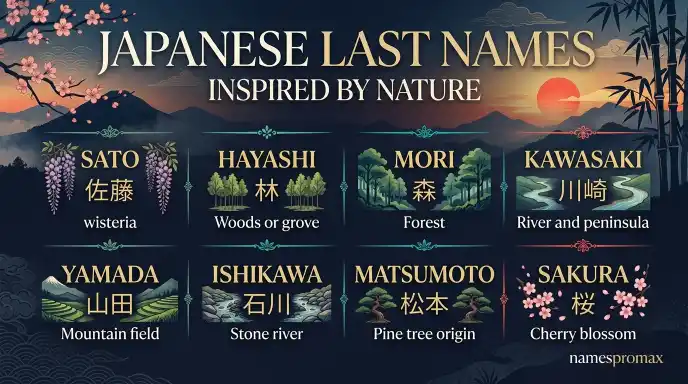
Japanese Last Names Inspired by Nature
Many Japanese surnames include characters for trees, forests, mountains, rivers, and fields. These names can feel especially meaningful if you enjoy nature or outdoor settings.
Hayashi: Often written 林, meaning “woods” or “forest.”
Mori: Often written 森, meaning “forest.”
Yamada: Often written 山田, meaning “mountain rice field.”
Kawasaki: Often written 川崎, with characters associated with a river and a point or cape.
Ishikawa: Often written 石川, meaning “stone river.”
Matsumoto: Often written 松本, meaning “base of the pine tree.”
Umemura: Can be written 梅村, meaning “plum village.”
Kikuchi: Has several possible kanji spellings, so the meaning can vary.
Okamoto: Often written 岡本, meaning “base of the hill.”
Shimizu: Often written 清水, meaning “clear water.”
Kurokawa: Often written 黒川, meaning “black river.”
Aoki: Often written 青木, commonly interpreted as “blue” or “green tree.”
Nature related surnames may have different meanings when written with other kanji. Always check the exact characters when accuracy matters.
Japanese Last Names and Their Meanings
A surname can have a clear literal meaning when its kanji are known. Still, romanized spellings alone do not always show which characters a family uses.
Fujimoto: Often written 藤本, meaning “base of the wisteria.”
Mizuno: Often written 水野, meaning “water field” or “water plain.”
Ogawa: Often written 小川, meaning “small river.”
Hoshino: Often written 星野, meaning “star field.”
Imai: Often written 今井, commonly read as “new” or “present” plus “well.”
Sakai: Can use different kanji, so its meaning depends on the family spelling.
Endo: Often written 遠藤, but other spellings exist.
Goto: Often written 後藤, though the meaning depends on the kanji used.
Kondo: Often written 近藤, a surname whose meaning is tied to its kanji combination.
Maeda: Often written 前田, meaning “front rice field.”
For a story or research project, write the kanji beside the romanized surname when you know it. This helps avoid giving a family a meaning that may not match its spelling.
Traditional Japanese Last Names
Some surnames have a long history and appear in records, literature, and family traditions. Their age and history can differ from one family to another.
Tachibana: A historic surname also associated with the tachibana citrus plant.
Fujiwara: A well known historical clan name, often written 藤原.
Minamoto: A historic clan name, also known as Genji in Japanese historical contexts.
Taira: A historic clan name associated with the Heike in Japanese history.
Ashikaga: A surname associated with a prominent samurai family and shogunate.
Tokugawa: A historic family name associated with the Tokugawa shogunate.
Hojo: A surname associated with a notable family in medieval Japanese history.
Oda: A surname associated with the Sengoku period leader Oda Nobunaga.
Date: A historic surname associated with the Date clan.
Shimazu: A historic surname associated with a powerful family from southern Japan.
Historical associations do not mean that every modern person with one of these surnames is related to a famous family.
Unique and Less Common Japanese Last Names
If you are looking for a surname that feels distinctive, consider names that may be less familiar internationally. Some are regional, and their frequency can vary across Japan.
Saionji: A surname associated with a historical aristocratic family.
Kujō: A historic surname associated with the Japanese court nobility.
Arisugawa: A surname connected with a former Japanese imperial princely house.
Kanzaki: A surname with several possible kanji spellings and meanings.
Tsukishima: Can be written with characters for “moon” and “island,” depending on the spelling.
Amamiya: Often associated with characters meaning “heaven” and “shrine,” though spellings vary.
Shiranui: A distinctive name also known from Japanese folklore and place names.
Kisaragi: A poetic word for the second month in an older Japanese calendar, also used as a name.
Yukimura: A surname with several possible kanji combinations.
Kamikawa: A surname that may use characters associated with “upper” and “river.”
For a fictional character, choose a spelling that fits the character’s background. A rare sounding name should not be treated as a standard surname without checking its use.
Japanese Last Names Related to Places and Landscapes
Japanese surnames often reflect where a family lived or the landscape around that place. These examples include references to villages, bridges, hills, and rivers.
Hashimoto: Often written 橋本, meaning “base of the bridge.”
Nakajima: Often written 中島, meaning “middle island.”
Fukushima: Often written 福島, meaning “fortunate island” in this kanji form.
Matsushima: Often written 松島, meaning “pine island.”
Nishimura: Often written 西村, meaning “west village.”
Higashiyama: Often written 東山, meaning “east mountain.”
Kitagawa: Often written 北川, meaning “north river.”
Minamino: Can be written in different ways, including forms connected with “south” and “field.”
Yoshida: Often written 吉田, commonly interpreted as “good fortune rice field.”
Nagasawa: Often written 長沢, often associated with a “long marsh” or “long swamp.”
These landscape meanings are useful clues, but a surname’s kanji may vary. Do not assume that a romanized spelling has only one meaning.

Japanese Last Names for Characters and Stories
If you are naming a character, think about the setting, age, family background, and tone of the story. A common surname can make a character feel familiar, while a historical or less common name may need more research.
Sato: A practical choice for an everyday contemporary character.
Tanaka: A familiar surname for a character in a modern setting.
Mori: A short surname with a forest related meaning in a common kanji form.
Shimizu: A recognizable option with a clear water association in one common spelling.
Tachibana: May suit a character in a historical or formal setting.
Fujiwara: Useful when the story intentionally refers to historical Japanese clans.
Kawasaki: A recognizable surname that can fit a contemporary character.
Hoshino: Has a star field association in one common kanji form.
Hashimoto: A familiar surname with a bridge related meaning in one common spelling.
Kisaragi: A stylized choice that may suit fiction, but its real world use should be checked.
Avoid choosing a surname only because it sounds foreign. Research the kanji, pronunciation, and cultural context, especially if the character is meant to reflect a real community.
Frequently Asked Questions About Japanese Last Names
1. What are the most common Japanese last names?
Answer: Sato, Suzuki, Takahashi, Tanaka, and Watanabe are among the best known and widely used Japanese surnames. Exact rankings may vary by source and year.
2. What do Japanese last names mean?
Answer: Many Japanese surnames refer to nature, land, or places. For example, Mori can mean “forest” and Ishikawa can mean “stone river” in common kanji forms. Meanings depend on the characters used.
3. Why can one Japanese surname have different meanings?
Answer: A romanized surname may be written with different kanji. Since each character can carry a different meaning, the exact family spelling matters.
4. Are Japanese last names written before first names?
Answer: In Japanese name order, the family name usually comes first, followed by the given name. In some international settings, people may use the Western order instead.
5. What are some Japanese last names inspired by nature?
Answer: Hayashi, Mori, Aoki, Shimizu, and Ishikawa are examples with common spellings linked to forests, trees, water, or rivers.
6. Can I use a Japanese last name for a fictional character?
Answer: Yes, but research its pronunciation, kanji, and cultural background. A common surname may suit a modern story, while a historical name may need more context.
7. Do all Japanese surnames have a clear meaning?
Answer: No. Some have several possible kanji spellings, and their historical meanings may be uncertain. It is best to check the exact written form.
Conclusion
Japanese last names offer a rich mix of nature references, place names, and family history. Sato, Suzuki, Tanaka, and Watanabe are familiar choices, while Mori, Hoshino, and Tachibana may appeal to readers looking for names with a particular feel or background.
Remember that a surname’s meaning depends on its kanji, so check the written characters when accuracy matters. With a little research, you can choose a surname that fits your project and respects its cultural context.
Related Naming Guides:
- Names Meaning Angel: Beautiful, Unique, and Meaningful Choices
- God Names Generator: 100+ Epic, Rare, and Powerful Ideas
- 150+ Gorgeous Girl Names That Start With W You’ll Instantly Love

I’m Cole Harrison, a naming enthusiast with 8 years of experience researching names, meanings, origins, and cultural influences. I love discovering names that are unique, memorable, and full of personality. Through my work, I help readers find the perfect names for babies, pets, characters, and creative projects.